
Binomial Heap
Introduction
A Binomial Heap is a collection of Binomial Trees that satisfies the Min Heap Property. Every Binomial Tree in the heap has a unique order, meaning that there cannot be two Binomial Trees having the same degree. The trees are maintained in increasing order of their degree.
Binomial Heaps are widely used in applications where frequent merging of priority queues is required.
Why Do We Need Binomial Heap?
Suppose two Binary Heaps need to be merged. Merging two Binary Heaps requires rebuilding the heap and may take O(n) time. A Binomial Heap performs the merge operation efficiently in only O(log n) time.
| Binary Heap | Binomial Heap |
|---|---|
| Merging is expensive. | Merging is very efficient. |
| Suitable for single priority queue. | Suitable for multiple priority queues. |
| No Binomial Trees. | Collection of Binomial Trees. |
| Merge Complexity : O(n) | Merge Complexity : O(log n) |
Real-Life Example
Consider a cloud computing server where several processors maintain their own priority queues. Whenever two processors are combined, their priority queues must also be merged. Instead of rebuilding an entirely new heap, a Binomial Heap performs the merge efficiently, making it suitable for cloud systems, operating systems, task scheduling, and network routing.
Characteristics of Binomial Heap
- Collection of Binomial Trees.
- Each tree satisfies the Min Heap Property.
- No two trees have the same degree.
- Trees are arranged in increasing order of degree.
- Supports efficient merging.
- Root with minimum key represents the minimum element.
Binomial Heap Illustration

Figure 1 : Example of a Binomial Heap consisting of Binomial Trees of different orders.

What is a Binomial Tree?
A Binomial Tree is a special recursive tree structure used to build a Binomial Heap. A Binomial Tree of order k, denoted as Bk, is formed by joining two Binomial Trees of order k−1.
Every Binomial Tree has the following characteristics:
- B0 contains only one node.
- B1 is obtained by linking two B0 trees.
- B2 is obtained by linking two B1 trees.
- B3 is obtained by linking two B2 trees.
- Each Binomial Tree of order k contains exactly 2k nodes.
Properties of Binomial Trees
| Property | Description |
|---|---|
| Number of Nodes | 2k |
| Height | k |
| Root Degree | k |
| Children | Ordered from highest degree to lowest degree |
| Construction | Merge two Binomial Trees of order k−1 |
Orders of Binomial Trees
The following figure illustrates Binomial Trees of different orders.

Figure 2 : Binomial Trees of Order 0, Order 1, Order 2 and Order 3.
Construction of Binomial Trees
The construction follows a recursive approach.
| Step | Operation |
|---|---|
| 1 | Create two Binomial Trees of Order 0. |
| 2 | Merge them to obtain Order 1. |
| 3 | Merge two Order 1 trees to obtain Order 2. |
| 4 | Merge two Order 2 trees to obtain Order 3. |
Solved Example
Step 1 Create two Binomial Trees of Order 1.
Step 2 Compare the roots.
Step 3 Attach the tree having the larger root as the leftmost child of the smaller root.
Result: A Binomial Tree of Order 2 containing four nodes is obtained.
- Every Binomial Tree follows the Min Heap Property.
- No two Binomial Trees in a Binomial Heap have the same order.
- The root of each Binomial Tree contains the minimum key of that tree.
Basic Operations on Binomial Heap
A Binomial Heap supports several efficient operations that make it more powerful than a Binary Heap when multiple priority queues need to be merged.
| Operation | Description |
|---|---|
| Make Heap | Create an empty Binomial Heap. |
| Insert | Insert a new key into the heap. |
| Find Minimum | Locate the smallest key stored in the heap. |
| Merge (Union) | Combine two Binomial Heaps into one. |
| Extract Minimum | Remove the minimum element. |
| Decrease Key | Reduce the value of a given key. |
| Delete | Delete any node from the heap. |
1. Make Heap Operation
Initially, the Binomial Heap is empty.
Initially there are no Binomial Trees present.
2. Insert Operation
Insertion is performed in three steps.
- Create a Binomial Heap containing only one node.
- Merge this heap with the existing Binomial Heap.
- If two trees have the same order, they are linked together.

Figure 3 : Insertion Operation in Binomial Heap.
Insert 15 into the following Binomial Heap.
Existing Heap
2 → 5 → 9
After inserting 15, a new Binomial Tree of Order 0 is created. It is merged with the existing heap. If another Order 0 tree already exists, both trees combine to form an Order 1 tree.
3. Find Minimum Operation
The minimum key always exists in one of the root nodes because every Binomial Tree satisfies the Min Heap Property.
The algorithm scans only the root list and returns the smallest root.
4. Merge (Union) Operation
The Merge or Union operation is the most important operation of a Binomial Heap. Two Binomial Heaps are merged by combining trees having the same order.
This operation is very similar to adding two binary numbers.

Figure 4 : Union (Merge) of Two Binomial Heaps.
5. Extract Minimum Operation
The Extract Minimum operation removes the smallest element from the Binomial Heap. Since the minimum element always exists among the root nodes, the algorithm first locates the minimum root, removes it, and then merges its children back into the remaining heap.
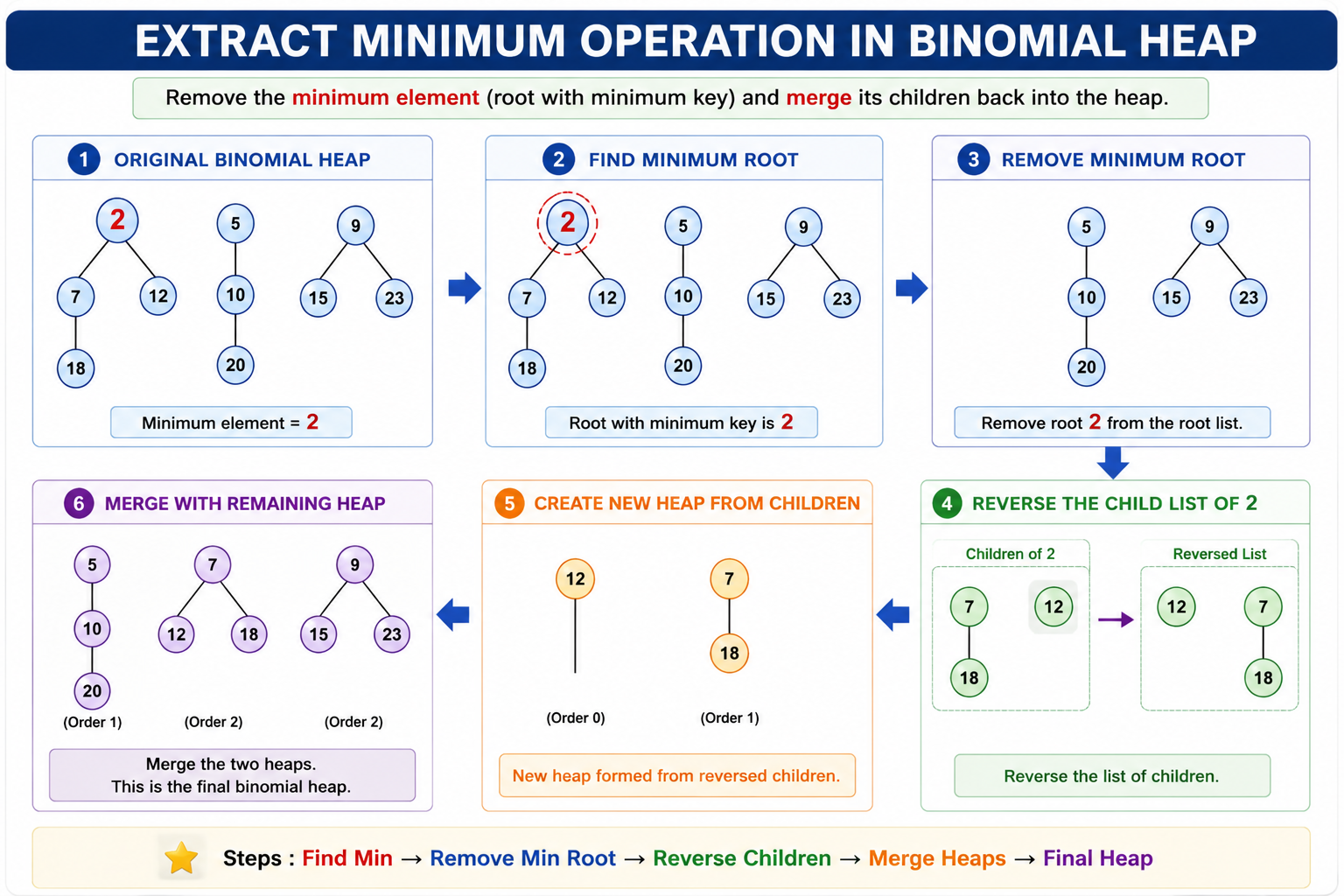
Figure 5 : Extract Minimum Operation in Binomial Heap.
Suppose the minimum key in the heap is 2.
Step 1 : Remove the root containing 2.
Step 2 : Separate all its child Binomial Trees.
Step 3 : Reverse the child list.
Step 4 : Merge them with the remaining Binomial Heap.
The resulting heap again satisfies all Binomial Heap properties.
6. Decrease Key Operation
The Decrease Key operation decreases the value of a given node. After decreasing the key, the Min Heap Property may be violated. Therefore, the node repeatedly exchanges its value with its parent until the heap property becomes valid.
This operation is commonly used in Dijkstra's Shortest Path Algorithm and Prim's Minimum Spanning Tree Algorithm.
7. Delete Operation
Deletion of any node is performed using the following two operations.
- Decrease the key value to negative infinity.
- Perform Extract-Min operation.
Complete Worked Example
Insert the following keys into an empty Binomial Heap.
10, 25, 5, 18, 30, 12, 40
| Step | Operation | Result |
|---|---|---|
| 1 | Insert 10 | Create Order-0 Tree |
| 2 | Insert 25 | Merge two Order-0 Trees → Order-1 Tree |
| 3 | Insert 5 | Create new Order-0 Tree |
| 4 | Insert 18 | Create another Order-0 Tree and Merge |
| 5 | Merge equal order trees | Create Order-2 Tree |
| 6 | Continue remaining insertions | Heap becomes balanced |

Figure 6 : Complete Example of Binomial Heap Construction.
Time Complexity Analysis
The following table summarizes the time complexity of various Binomial Heap operations.
| Operation | Time Complexity | Explanation |
|---|---|---|
| Create Heap | O(1) | Create an empty heap. |
| Find Minimum | O(log n) | Traverse all root nodes. |
| Insert | O(log n) | Insert and merge trees. |
| Merge (Union) | O(log n) | Merge root lists and combine equal-order trees. |
| Extract Minimum | O(log n) | Delete minimum root and merge children. |
| Decrease Key | O(log n) | Bubble the node upward. |
| Delete | O(log n) | Decrease key followed by Extract-Min. |
| Space Complexity | O(n) | Stores all nodes. |
Advantages of Binomial Heap
- Efficient merging of two heaps.
- Supports all priority queue operations efficiently.
- Suitable for dynamic applications.
- Maintains balanced Binomial Trees.
- Easy implementation of Union operation.
- Useful in graph algorithms.
Disadvantages of Binomial Heap
- Implementation is more complex than Binary Heap.
- Find-Min requires scanning root nodes.
- Consumes additional pointer memory.
- Not suitable for small datasets.
Applications of Binomial Heap
- Priority Queue implementation.
- Dijkstra's Shortest Path Algorithm.
- Prim's Minimum Spanning Tree Algorithm.
- Operating System Scheduling.
- Network Routing.
- Artificial Intelligence Search Algorithms.
- Cloud Computing Task Scheduling.
- Job Scheduling Systems.
Comparison : Binary Heap vs Binomial Heap
| Binary Heap | Binomial Heap |
|---|---|
| Single Binary Tree | Collection of Binomial Trees |
| Merge : O(n) | Merge : O(log n) |
| Simple implementation | Complex implementation |
| Suitable for one priority queue | Suitable for multiple priority queues |
| Less flexible | Highly flexible |
Frequently Asked Interview Questions
- What is a Binomial Heap?
- What is a Binomial Tree?
- How is a Binomial Heap different from a Binary Heap?
- Explain the Merge (Union) operation.
- How is Delete operation performed?
- Why is Extract-Min efficient?
- What is the degree of a Binomial Tree?
- Where is Binomial Heap used?
- Explain Decrease-Key operation.
- What is the time complexity of Merge?
Practice Questions
- Construct a Binomial Heap by inserting 10, 20, 5, 30, 40, 15.
- Perform Union operation on two Binomial Heaps.
- Perform Extract-Min operation.
- Delete node containing key 25.
- Explain Binomial Trees of Order 0 to Order 4.
Key Takeaways
- A Binomial Heap is a collection of Binomial Trees.
- No two Binomial Trees have the same degree.
- Merge operation is the biggest advantage.
- All operations take O(log n) time.
- Widely used in graph algorithms and priority queues.

Summary
A Binomial Heap is an efficient priority queue data structure that supports fast insertion, deletion, merging and minimum element extraction. Its unique ability to merge two heaps in O(log n) time makes it superior to Binary Heap in applications involving multiple priority queues. It is widely used in graph algorithms, operating systems, scheduling, network routing and cloud computing.